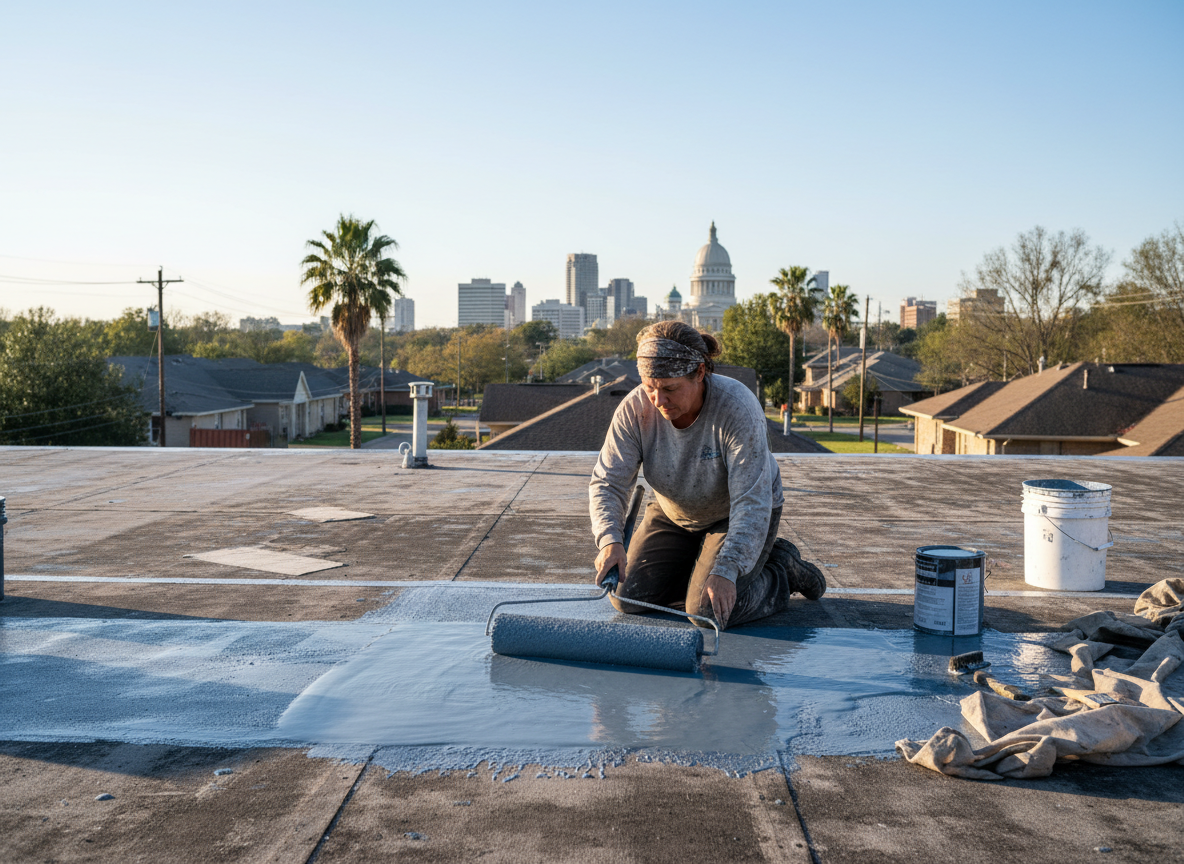
Roof waterproofing in Montgomery requires attention to the region's frequent thunderstorms and high humidity that drive repeated expansion and contraction on asphalt and metal roofs common in older stock around Capitol Heights and Highland Gardens. Liquid-applied elastomeric coatings bond directly to existing surfaces but demand thorough cleaning to remove mildew and oxidation that trap moisture beneath the membrane. Edge detailing around vents, skylights, and valleys must extend at least six inches up vertical surfaces to prevent wind-driven rain from entering under the coating.
Homeowners often overlook parapet walls and low-slope sections on ranch-style homes built in the 1960s and 1970s, where ponding water accelerates coating failure within two seasons. We use reinforced fabric at seams and transitions because single-ply applications crack at those points when temperatures swing rapidly after summer storms. Proper ventilation checks during prep also reduce the risk of trapped vapor that blisters new waterproofing layers from below.
Montgomery County building practices favor self-adhered underlayment extensions at eaves for ice-dam equivalent protection during rare freezes, yet most waterproofing jobs here focus on UV and moisture resistance instead. Skipping primer on weathered shingles leads to delamination within months, especially on south-facing slopes that receive the strongest afternoon sun. We always verify deck integrity before coating because rotted plywood under old layers will telegraph movement and split the new membrane.
Seasonal timing matters: applications after heavy spring rains allow the roof to dry fully, while late-fall work risks cooler nights slowing cure times and trapping solvents. In neighborhoods near the Alabama River, elevated moisture levels from nearby water bodies make breathable coatings preferable to fully impermeable ones that can hold condensation against the deck.
Technician insight
In Montgomery, the thing that catches most people out with roof waterproofing is how humidity and sudden downpours on 1960s-70s homes in Capitol Heights cause coatings to fail at unsealed seams if prep skips proper drying time after storms.
Recurring Leak on Low-Slope Section
Homeowner reported water stains after spring storms on a ranch in Highland Gardens. We found ponding at a poorly flashed skylight and degraded coating on the flat section. After cleaning, reinforcing the seam, and applying a new reinforced membrane system the leaks stopped and drainage improved.
How it works
- 1
Site Assessment
Inspect roof slope, existing membrane condition, and all penetrations while noting drainage patterns specific to Montgomery homes.
- 2
Surface Preparation
Power wash to remove mildew and loose granules, then repair blisters, seams, and flashing before any coating application.
- 3
Detail Work
Apply reinforced fabric and sealant at valleys, vents, and wall transitions to handle wind-driven rain common in the area.
- 4
Coating Application
Roll or spray the chosen elastomeric system in two coats with proper mil thickness, allowing full cure between passes.
- 5
Final Inspection
Check for uniform coverage, proper drainage, and adhesion before signing off and scheduling any needed follow-up.
Pricing
Pricing varies by roof size, pitch, and existing condition; we provide upfront quotes after inspection.